Advanced Driver Assistance Systems (ADAS) support drivers in fulfilling their driving task by reducing workload and enabling a more safe and comfortable drive. However, the increasing market penetration of ADAS, along with the wide variety of types and models, has led to a need for a cost and time-efficient way to integrate and parametrize new systems. One essential point for the integration process of comfort-oriented ADAS is the question of driver satisfaction with respect to safety, reliability, trust and comfort. The current work offers a method for parametrizing an ADAS controller with the help of test drives with non-professional drivers. The proposed method is validated by the parametrization of an Adaptive Cruise Control (ACC) system, which supports the driver by keeping a desired vehicle speed or defined distance to a proceeding slower moving vehicle, the Object to Follow (OTF). For the selection of the OTF, the prediction of the future path of the own vehicle (ego vehicle) is an essential part of the ACC system. Today, different algorithms are implemented for path prediction. To evaluate these algorithms, test drives were carried out with a specially equipped vehicle with non-professional test drivers. Based on the measured data, different methods for path prediction were compared. A novel steering prediction algorithm was developed, which is used in combination with a linear Single-Track Model (STM) to predict the ego vehicle’s path. Based on the predicted ego vehicle path, the OTF is selected, which is then used to parametrize a novel ACC controller. The performance of the controller fulfils previously defined safety and comfort requirements, as well as string stability. Simulations with the recorded OTF data as input were carried out, which showed that the ACC controller is able to simulate the behaviour of the human driver. Furthermore, the controller cuts acceleration peaks, which leads to a more comfortable feeling than with the measurements obtained when the human drove the vehicle. Finally, a comparison with measurements of a state-of-the-art ACC system showed similar behaviour compared to the production controller in following another vehicle. The results of the present study show that the proposed method is able to identify an appropriate set of parameters for an ACC controller. The idea of parametrizing the controllers with the help of human test driver should lead to a human-like behaviour and increase customer acceptance of the system. Additionally, this optimized parametrization method will help to shorten the development and validation process, which is very important for saving costs.
Parametrization of an Adaptive Cruise Control System Based on Test Drives
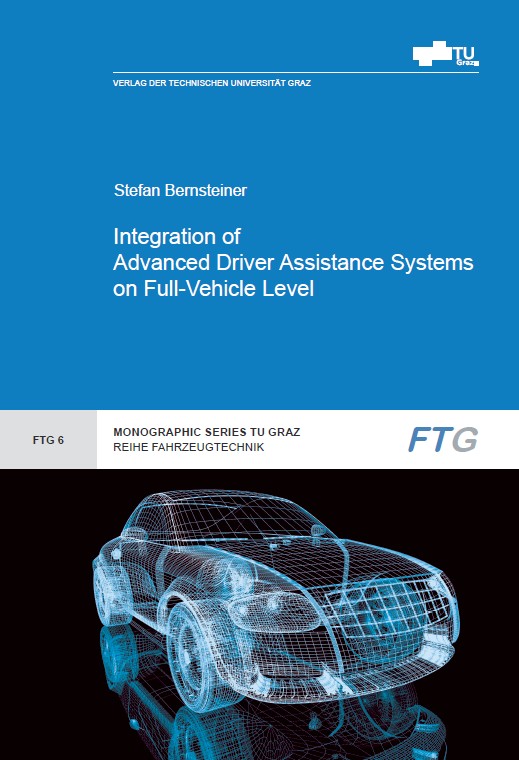
Parametrization of an Adaptive Cruise Control System Based on Test Drives
Issue: Open Access E-Book
ISBN: 978-3-85125-469-3
Scope: 112 pages
Language: Englisch
Release date: June 2016
Series: Monographic Series TU Graz / Reihe Fahrzeugtechnik, Issue 6
Advanced Driver Assistance Systems (ADAS) support drivers in fulfilling their driving task by reducing workload and enabling a more safe and comfortable drive. However, the increasing market penetration of ADAS, along with the wide variety of types and models, has led to a need for a cost and time-efficient way to integrate and parametrize new systems. One essential point for the integration process of comfort-oriented ADAS is the question of driver satisfaction with respect to safety, reliability, trust and comfort. The current work offers a method for parametrizing an ADAS controller with the help of test drives with non-professional drivers. The proposed method is validated by the parametrization of an Adaptive Cruise Control (ACC) system, which supports the driver by keeping a desired vehicle speed or defined distance to a proceeding slower moving vehicle, the Object to Follow (OTF). For the selection of the OTF, the prediction of the future path of the own vehicle (ego vehicle) is an essential part of the ACC system. Today, different algorithms are implemented for path prediction. To evaluate these algorithms, test drives were carried out with a specially equipped vehicle with non-professional test drivers. Based on the measured data, different methods for path prediction were compared. A novel steering prediction algorithm was developed, which is used in combination with a linear Single-Track Model (STM) to predict the ego vehicle’s path. Based on the predicted ego vehicle path, the OTF is selected, which is then used to parametrize a novel ACC controller. The performance of the controller fulfils previously defined safety and comfort requirements, as well as string stability. Simulations with the recorded OTF data as input were carried out, which showed that the ACC controller is able to simulate the behaviour of the human driver. Furthermore, the controller cuts acceleration peaks, which leads to a more comfortable feeling than with the measurements obtained when the human drove the vehicle. Finally, a comparison with measurements of a state-of-the-art ACC system showed similar behaviour compared to the production controller in following another vehicle. The results of the present study show that the proposed method is able to identify an appropriate set of parameters for an ACC controller. The idea of parametrizing the controllers with the help of human test driver should lead to a human-like behaviour and increase customer acceptance of the system. Additionally, this optimized parametrization method will help to shorten the development and validation process, which is very important for saving costs.
-
Helmut Eichlseder (Hrsg.)
100 Jahre Institut für Verbrennungskraftmaschinen und Thermodynamik
€ 70.00 Add to cart -
Christian Landschützer (Hrsg.)
Nachhaltige Logistik
€ 29.00 Add to cart -
Christian Landschützer (Hrsg.)
Nachhaltige Logistik
OPEN ACCESS E-BOOK
Read more
Induktionsfügen von thermoplastischen Faserverbundwerkstoffen
€ 28.00 Add to cart
- Catalog
- Sale
-
Open Access publications

-
Series
- Akademische Reden an der Technischen Universität Graz
- Arbeitshilfen für die Praxis
- Archiv und Bibliothek
- Betonkolloquium
- Buddhist Architecture in the Western Himalayas
- BWL Schriftenreihe
- Electrical Power Systems
- Fachbücher Planung und Bau
- Facts & Figures
- Festschriften TU Graz
- Forschungsreihe IBBW
- Forum Technik und Gesellschaft
- Geodesy
- Immersive Learning Research Network Conference; Workshop, short papers, poster
- LM.VM.2014
- Logistik Werkstatt Graz
- Materialien zu Schwerpunkten am Institut für Gebäudelehre
- Mathematical Modelling of Weld Phenomena
- Monographic Series TU Graz
- Monographic Series TU Graz|Advanced Materials Science
- Monographic Series TU Graz|Computation in Engineering and Science
- Monographic Series TU Graz|Production Science and Management
- Monographic Series TU Graz|Railway Research
- Monographic Series TU Graz|Reihe Fahrzeugtechnik
- Monographic Series TU Graz|Schriftenreihe des Instituts Betonbau
- Monographic Series TU Graz|Structural Analysis
- Monographic Series TU Graz|Techno- und sozioökonomisch orientierte Betriebswirtschaft
- Monographic Series TU Graz|Technoökonomie und industrielles Management
- Monographic Series TU Graz|Timber Engineering & Technology
- November Talks
- Proceedings of the International Brain-Computer Interface
- Projektmanagement in der Bau- und Immobilienwirtschaft|Level D Bauprojekt Management
- Schriftenreihe des Instituts für Baubetrieb und Bauwirtschaft
- Schriftenreihe des Instituts für Straßen- und Verkehrswesen
- Schriftenreihe des Instituts für Wohnbau der TU Graz
- Schriftenreihe zur Wasserwirtschaft
- Science, Technology and Society online
- Seminarreihe Bauunternehmensführung
- Studien zur Architektur | TU Graz
- Textbook Series
- TU Graz Jahresbericht | Annual report
- TU Graz people
- TU Graz Research
- VKM-THD Mitteilungen; IVT-Mitteilungen ab Bd. 100
- Authors
- Events