Preface:
This interdisciplinary training program for young scientists started as a co-operative project of Graz University
of Technology and the Yokohama National University in the year 2008. The training program grew quickly, both in
the number of participants as well as in the number of participating international experts in the field of fuel cell
research. This proceeding includes short abstracts along with key slides from the presentation of the lecturers of
the 6th International Summer School.
The training program covers research topics in the fields of hydrogen production, basic electrochemistry,
thermodynamics, kinetics and catalysis as well as the design and development of the complete fuel cell systems.
The goals of the training are to provide the necessary theoretical background to the young scientists and to make
the young scientists more aware of the need to work closely with colleagues from different fields such as the
natural sciences and engineering departments in order to successfully develop and implement this technology.
The lectures cover following topics:
•Basic principle of fuel cells
•Basic electrochemistry
•Measurement and Characterization Techniques
•PEFC Lifetime and Degradation
•PEFC Applications
•Hydrogen as Fuel
•Hydrogen Production and Heterogeneous Catalysis
•Advanced Material Studies
In 1839, Schönbein and Grove described the working principle of a fuel cell. Since then, it was often claimed
during a number of fuel cell hypes that fuel cells will soon replace conventional power production technologies. So
why don’t we use fuel cells nowadays in our daily life? “Economic lifetime” might be the shortest answer, although
the commercialization process of residential co-generation systems started in Japan in the year 2009. Currently
are approx. 40,000 systems are in operation with the financial support of the Japanese government. Key industrial
players push the commercialization of electric vehicles and mobile applications, even during times of economic
stagnation. Research institutions and universities are covering all aspects from basic research to system
development in a wide range as never seen before in history. So, this should be the basis to bring this interesting,
high efficient and clean technology finally to the market.
Potential applications include portable equipment like laptop computers and cordless phones, mobile
applications like hybrid vehicles and stationary power plants ranging from 1 kW to the MW-class. The main
advantageous features of fuel cells are the high energy conversion efficiencies, low emissions and hopefully with
further development, their long lifespan.
Mobile applications get special priority in fuel cell research and development; however mobile applications are
usually tied to a controversial issue: hydrogen as fuel. Discourse covering hydrogen production technologies,
transportation and storage of hydrogen will provide the basis for intensive discussions about advantages and
disadvantages of this future fuel. Emphasis will be given to “green hydrogen”, produced from renewable energy
sources, e.g. water electrolysis with electricity generated by wind turbines or solar cells.
I would also like to especially thank Dr. Hiroshi Fukutomi, Ms. Carmen Gehrer and Ms. Kauzo Tsukada for their
professional support in the organization of the summer program as well as all of the lecturers who contributed so
much to this effort.
Yokohama, August 25th, 2013
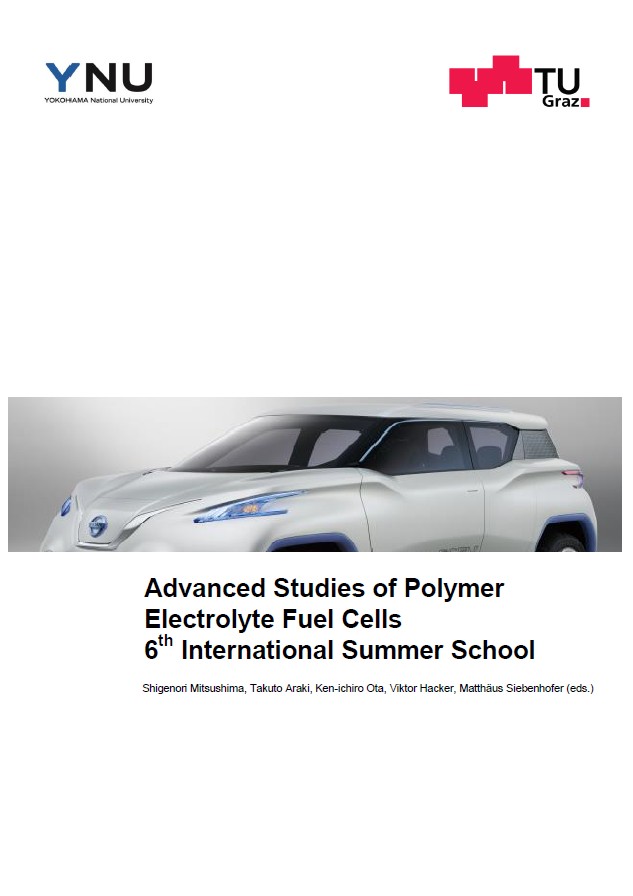
ISBN: 978-3-85125-271-2
Scope: 181 pages
Language: Englisch
Release date: October 2013
€ 30.00
Preface:
This interdisciplinary training program for young scientists started as a co-operative project of Graz University
of Technology and the Yokohama National University in the year 2008. The training program grew quickly, both in
the number of participants as well as in the number of participating international experts in the field of fuel cell
research. This proceeding includes short abstracts along with key slides from the presentation of the lecturers of
the 6th International Summer School.
The training program covers research topics in the fields of hydrogen production, basic electrochemistry,
thermodynamics, kinetics and catalysis as well as the design and development of the complete fuel cell systems.
The goals of the training are to provide the necessary theoretical background to the young scientists and to make
the young scientists more aware of the need to work closely with colleagues from different fields such as the
natural sciences and engineering departments in order to successfully develop and implement this technology.
The lectures cover following topics:
•Basic principle of fuel cells
•Basic electrochemistry
•Measurement and Characterization Techniques
•PEFC Lifetime and Degradation
•PEFC Applications
•Hydrogen as Fuel
•Hydrogen Production and Heterogeneous Catalysis
•Advanced Material Studies
In 1839, Schönbein and Grove described the working principle of a fuel cell. Since then, it was often claimed
during a number of fuel cell hypes that fuel cells will soon replace conventional power production technologies. So
why don’t we use fuel cells nowadays in our daily life? “Economic lifetime” might be the shortest answer, although
the commercialization process of residential co-generation systems started in Japan in the year 2009. Currently
are approx. 40,000 systems are in operation with the financial support of the Japanese government. Key industrial
players push the commercialization of electric vehicles and mobile applications, even during times of economic
stagnation. Research institutions and universities are covering all aspects from basic research to system
development in a wide range as never seen before in history. So, this should be the basis to bring this interesting,
high efficient and clean technology finally to the market.
Potential applications include portable equipment like laptop computers and cordless phones, mobile
applications like hybrid vehicles and stationary power plants ranging from 1 kW to the MW-class. The main
advantageous features of fuel cells are the high energy conversion efficiencies, low emissions and hopefully with
further development, their long lifespan.
Mobile applications get special priority in fuel cell research and development; however mobile applications are
usually tied to a controversial issue: hydrogen as fuel. Discourse covering hydrogen production technologies,
transportation and storage of hydrogen will provide the basis for intensive discussions about advantages and
disadvantages of this future fuel. Emphasis will be given to “green hydrogen”, produced from renewable energy
sources, e.g. water electrolysis with electricity generated by wind turbines or solar cells.
I would also like to especially thank Dr. Hiroshi Fukutomi, Ms. Carmen Gehrer and Ms. Kauzo Tsukada for their
professional support in the organization of the summer program as well as all of the lecturers who contributed so
much to this effort.
Yokohama, August 25th, 2013
- Catalog
- Sale
-
Open Access publications

-
Series
- Akademische Reden an der Technischen Universität Graz
- Arbeitshilfen für die Praxis
- Archiv und Bibliothek
- Betonkolloquium
- Buddhist Architecture in the Western Himalayas
- BWL Schriftenreihe
- Electrical Power Systems
- Fachbücher Planung und Bau
- Facts & Figures
- Festschriften TU Graz
- Forschungsreihe IBBW
- Forum Technik und Gesellschaft
- Geodesy
- Immersive Learning Research Network Conference; Workshop, short papers, poster
- LM.VM.2014
- Logistik Werkstatt Graz
- Materialien zu Schwerpunkten am Institut für Gebäudelehre
- Mathematical Modelling of Weld Phenomena
- Monographic Series TU Graz
- Monographic Series TU Graz|Advanced Materials Science
- Monographic Series TU Graz|Computation in Engineering and Science
- Monographic Series TU Graz|Production Science and Management
- Monographic Series TU Graz|Railway Research
- Monographic Series TU Graz|Reihe Fahrzeugtechnik
- Monographic Series TU Graz|Schriftenreihe des Instituts Betonbau
- Monographic Series TU Graz|Structural Analysis
- Monographic Series TU Graz|Techno- und sozioökonomisch orientierte Betriebswirtschaft
- Monographic Series TU Graz|Technoökonomie und industrielles Management
- Monographic Series TU Graz|Timber Engineering & Technology
- November Talks
- Proceedings of the International Brain-Computer Interface
- Projektmanagement in der Bau- und Immobilienwirtschaft|Level D Bauprojekt Management
- Schriftenreihe des Instituts für Baubetrieb und Bauwirtschaft
- Schriftenreihe des Instituts für Straßen- und Verkehrswesen
- Schriftenreihe des Instituts für Wohnbau der TU Graz
- Schriftenreihe zur Wasserwirtschaft
- Science, Technology and Society online
- Seminarreihe Bauunternehmensführung
- Studien zur Architektur | TU Graz
- Textbook Series
- TU Graz Jahresbericht | Annual report
- TU Graz people
- TU Graz Research
- VKM-THD Mitteilungen; IVT-Mitteilungen ab Bd. 100
- Authors
- Events