Today, automotive development has to face a broad spectrum of numerous exciting challenges. For instance, the imminent shortage of fossil energy in combination with the increasing urbanisation leads to discussions in the direction of alternative and innovative drive-trains, usage of regenerative energy sources and lighter as well as more efficient cars. This causes automotive companies to think about new vehicle architectures, which can be flexibly adapted to the specific market and customer needs. Because of today’s globalisation of the automotive customer market, vehicle producers have to face a growing number of competitors. This leads to the attempt to reduce the required development time, to be present on the global market with innovative product solutions as fast as possible. From the process point of view there are two basic mechanisms, which are used simultaneously to meet this challenge: On the one hand there are strong efforts to increase the product knowledge in early phases of the development process (front-loading). On the other hand there are attempts to parallelise specific sections of the development process, in order to reduce the required development time or to use the gained time to analyse more concept variants (concurrent engineering). This has extensive implications on the entire vehicle: The so called vehicle architecture department is accounted for the overall physical representation of the vehicle. This department defines the authorised technological spaces within the car and moderates spatial conflicts during the technical development and solution finding process. Because of the increasing number of vehicle functions and rising demands the available technical space within the car decreases despite the trend of rising exterior dimensions. This requires the exploration of functional aspects of the vehicle concept besides the traditional sole geometrical considerations already in the preliminary development phase. In order to support the entire vehicle development in the early concept phase, a novel approach for an integrated concept model is introduced. The basic idea of the approach is to enable a consistent interconnection between CAx-applications and expert tools in the context of the entire vehicle, in order to allow the efficient evaluation of geometrical and functional vehicle aspects of a concept. Because of the strong geometric focus of a vehicle architecture department, the core of the approach is a parametric-associative master-model, which contains all essential elements for the representation of the geometrical aspects of a concept. The use of interfaces and automation-based routines allows the bidirectional linkage with calculations and simulation models with the master-model. The master-model is fully maintained by implemented control routines, which allows the provision of a flexible parametrisation within the integrated concept model. This enables a variable adaptation of the implemented model relations according to the requirements of the concept. Furthermore, the data model allows the representation of different states (e.g. target-state, current-state), in order to satisfy the process-related demands within the conceptual development. Besides the representation of a virtual vehicle model, the presented approach offers a knowledge-based dimension. The application of a specialised evaluation system and archiving logic allows the storage of the engineering knowledge generated during the conceptual development. This supports an efficient and comprehensible reuse of the engineering knowledge in later project phases or in new vehicle projects.par
The practical realisation of the stated approach is shown by means of selected examples in the area of conceptual development.
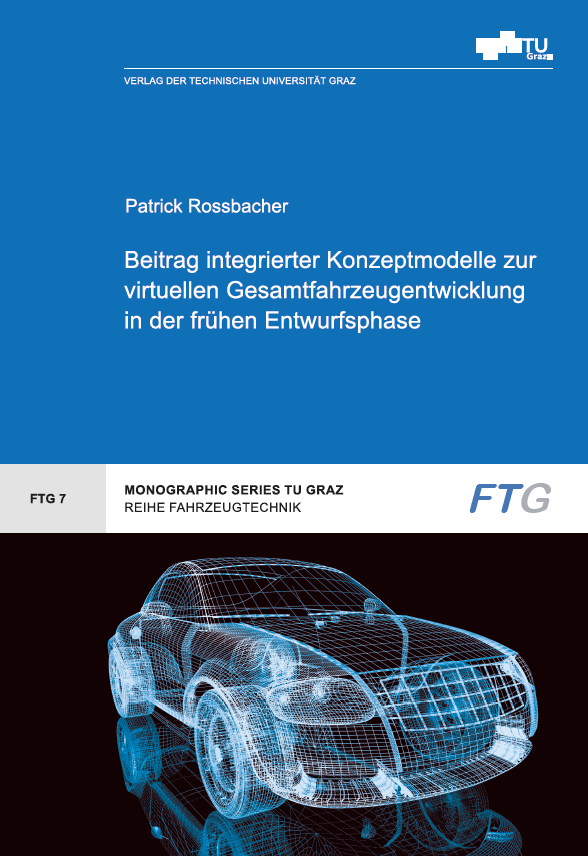
Issue: Open Access E-Book
ISBN: 978-3-85125-731-1
Scope: 276 pages
Language: Deutsch
Release date: March 2020
Series: Monographic Series TU Graz / Reihe Fahrzeugtechnik, Issue 7
Today, automotive development has to face a broad spectrum of numerous exciting challenges. For instance, the imminent shortage of fossil energy in combination with the increasing urbanisation leads to discussions in the direction of alternative and innovative drive-trains, usage of regenerative energy sources and lighter as well as more efficient cars. This causes automotive companies to think about new vehicle architectures, which can be flexibly adapted to the specific market and customer needs. Because of today’s globalisation of the automotive customer market, vehicle producers have to face a growing number of competitors. This leads to the attempt to reduce the required development time, to be present on the global market with innovative product solutions as fast as possible. From the process point of view there are two basic mechanisms, which are used simultaneously to meet this challenge: On the one hand there are strong efforts to increase the product knowledge in early phases of the development process (front-loading). On the other hand there are attempts to parallelise specific sections of the development process, in order to reduce the required development time or to use the gained time to analyse more concept variants (concurrent engineering). This has extensive implications on the entire vehicle: The so called vehicle architecture department is accounted for the overall physical representation of the vehicle. This department defines the authorised technological spaces within the car and moderates spatial conflicts during the technical development and solution finding process. Because of the increasing number of vehicle functions and rising demands the available technical space within the car decreases despite the trend of rising exterior dimensions. This requires the exploration of functional aspects of the vehicle concept besides the traditional sole geometrical considerations already in the preliminary development phase. In order to support the entire vehicle development in the early concept phase, a novel approach for an integrated concept model is introduced. The basic idea of the approach is to enable a consistent interconnection between CAx-applications and expert tools in the context of the entire vehicle, in order to allow the efficient evaluation of geometrical and functional vehicle aspects of a concept. Because of the strong geometric focus of a vehicle architecture department, the core of the approach is a parametric-associative master-model, which contains all essential elements for the representation of the geometrical aspects of a concept. The use of interfaces and automation-based routines allows the bidirectional linkage with calculations and simulation models with the master-model. The master-model is fully maintained by implemented control routines, which allows the provision of a flexible parametrisation within the integrated concept model. This enables a variable adaptation of the implemented model relations according to the requirements of the concept. Furthermore, the data model allows the representation of different states (e.g. target-state, current-state), in order to satisfy the process-related demands within the conceptual development. Besides the representation of a virtual vehicle model, the presented approach offers a knowledge-based dimension. The application of a specialised evaluation system and archiving logic allows the storage of the engineering knowledge generated during the conceptual development. This supports an efficient and comprehensible reuse of the engineering knowledge in later project phases or in new vehicle projects.par
The practical realisation of the stated approach is shown by means of selected examples in the area of conceptual development.
-
Helmut Eichlseder (Hrsg.)
100 Jahre Institut für Verbrennungskraftmaschinen und Thermodynamik
€ 70.00 Add to cart -
Christian Landschützer (Hrsg.)
Nachhaltige Logistik
€ 29.00 Add to cart -
Christian Landschützer (Hrsg.)
Nachhaltige Logistik
OPEN ACCESS E-BOOK
Read more
Induktionsfügen von thermoplastischen Faserverbundwerkstoffen
€ 28.00 Add to cart
- Catalog
- Sale
-
Open Access publications

-
Series
- Akademische Reden an der Technischen Universität Graz
- Arbeitshilfen für die Praxis
- Archiv und Bibliothek
- Betonkolloquium
- Buddhist Architecture in the Western Himalayas
- BWL Schriftenreihe
- Electrical Power Systems
- Fachbücher Planung und Bau
- Facts & Figures
- Festschriften TU Graz
- Forschungsreihe IBBW
- Forum Technik und Gesellschaft
- Geodesy
- Immersive Learning Research Network Conference; Workshop, short papers, poster
- LM.VM.2014
- Logistik Werkstatt Graz
- Materialien zu Schwerpunkten am Institut für Gebäudelehre
- Mathematical Modelling of Weld Phenomena
- Monographic Series TU Graz
- Monographic Series TU Graz|Advanced Materials Science
- Monographic Series TU Graz|Computation in Engineering and Science
- Monographic Series TU Graz|Production Science and Management
- Monographic Series TU Graz|Railway Research
- Monographic Series TU Graz|Reihe Fahrzeugtechnik
- Monographic Series TU Graz|Schriftenreihe des Instituts Betonbau
- Monographic Series TU Graz|Structural Analysis
- Monographic Series TU Graz|Techno- und sozioökonomisch orientierte Betriebswirtschaft
- Monographic Series TU Graz|Technoökonomie und industrielles Management
- Monographic Series TU Graz|Timber Engineering & Technology
- November Talks
- Proceedings of the International Brain-Computer Interface
- Projektmanagement in der Bau- und Immobilienwirtschaft|Level D Bauprojekt Management
- Schriftenreihe des Instituts für Baubetrieb und Bauwirtschaft
- Schriftenreihe des Instituts für Straßen- und Verkehrswesen
- Schriftenreihe des Instituts für Wohnbau der TU Graz
- Schriftenreihe zur Wasserwirtschaft
- Science, Technology and Society online
- Seminarreihe Bauunternehmensführung
- Studien zur Architektur | TU Graz
- Textbook Series
- TU Graz Jahresbericht | Annual report
- TU Graz people
- TU Graz Research
- VKM-THD Mitteilungen; IVT-Mitteilungen ab Bd. 100
- Authors
- Events