The numerical simulation of turbulent heat transfer at high molecular Prandtl numbers is still strongly challenged by disparate thicknesses of the viscous sublayer for velocity and enthalpy. The model assumption for the prescription of the thermal boundary conditions in Reynolds Averaged Navier-Stokes (RANS) type simulations becomes increasingly questionable for high molecular Prandtl numbers, where the Reynolds analogy between the momentum and the heat transfer breaks down.
The present work addresses this issue by performing Direct Numerical Simulation (DNS) for relatively high molecular Prandtl number, up to Pr=50, including temperature-dependent fluid properties. The variation of all flow quantities, due to varying fluid properties is extensively examined by a comparison against results from DNS with constant fluid properties.
All DNS results are further validated against measurements, obtained on a test facility, specially designed and constructed for this purpose. The agreement of the simulated skin-friction coefficient and Nusselt numbers with the experiments is excellent, indicating the high reliability of the presented DNS results.
This DNS database was utilized for the evaluation and further development of two popular modeling approaches for RANS-type thermal boundary condition, the so-called P-function and a simple two-layer model. Based on the DNS results, various modifications for either approach are proposed, providing in particular appropriate submodels for the turbulent Prandtl number, the eddy viscosity, and incorporating an analytical solution for the ratio of the total shear stress and the total heat flux. The resulting modified formulations are capable of reproducing very accurately the DNS results as well as the experimental data which covers also a Reynolds numbers not amenable to DNS.
A modelling approach based on Direct Numerical Simulations and experiments
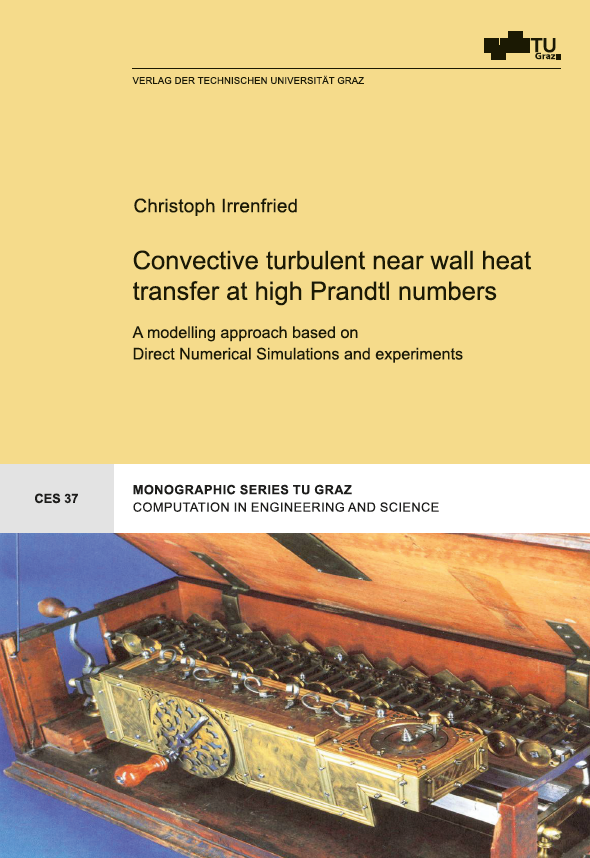
A modelling approach based on Direct Numerical Simulations and experiments
Issue: Open Access E-Book
ISBN: 978-3-85125-725-0
Scope: 227 pages
Language: Englisch
Release date: March 2020
Series: Monographic Series TU Graz / Computation in Engineering and Science, Issue 37
The numerical simulation of turbulent heat transfer at high molecular Prandtl numbers is still strongly challenged by disparate thicknesses of the viscous sublayer for velocity and enthalpy. The model assumption for the prescription of the thermal boundary conditions in Reynolds Averaged Navier-Stokes (RANS) type simulations becomes increasingly questionable for high molecular Prandtl numbers, where the Reynolds analogy between the momentum and the heat transfer breaks down.
The present work addresses this issue by performing Direct Numerical Simulation (DNS) for relatively high molecular Prandtl number, up to Pr=50, including temperature-dependent fluid properties. The variation of all flow quantities, due to varying fluid properties is extensively examined by a comparison against results from DNS with constant fluid properties.
All DNS results are further validated against measurements, obtained on a test facility, specially designed and constructed for this purpose. The agreement of the simulated skin-friction coefficient and Nusselt numbers with the experiments is excellent, indicating the high reliability of the presented DNS results.
This DNS database was utilized for the evaluation and further development of two popular modeling approaches for RANS-type thermal boundary condition, the so-called P-function and a simple two-layer model. Based on the DNS results, various modifications for either approach are proposed, providing in particular appropriate submodels for the turbulent Prandtl number, the eddy viscosity, and incorporating an analytical solution for the ratio of the total shear stress and the total heat flux. The resulting modified formulations are capable of reproducing very accurately the DNS results as well as the experimental data which covers also a Reynolds numbers not amenable to DNS.
-
Helmut Eichlseder (Hrsg.)
100 Jahre Institut für Verbrennungskraftmaschinen und Thermodynamik
€ 70.00 Add to cart -

Christian Landschützer (Hrsg.)
Nachhaltige Logistik
€ 29.00 Add to cart -

Christian Landschützer (Hrsg.)
Nachhaltige Logistik
OPEN ACCESS E-BOOK
Read more
Induktionsfügen von thermoplastischen Faserverbundwerkstoffen
€ 28.00 Add to cart
- Catalog
- Sale
-
Open Access publications

-
Series
- Akademische Reden an der Technischen Universität Graz
- Arbeitshilfen für die Praxis
- Archiv und Bibliothek
- Betonkolloquium
- Buddhist Architecture in the Western Himalayas
- BWL Schriftenreihe
- Electrical Power Systems
- Fachbücher Planung und Bau
- Facts & Figures
- Festschriften TU Graz
- Forschungsreihe IBBW
- Forum Technik und Gesellschaft
- Geodesy
- Immersive Learning Research Network Conference; Workshop, short papers, poster
- LM.VM.2014
- Logistik Werkstatt Graz
- Materialien zu Schwerpunkten am Institut für Gebäudelehre
- Mathematical Modelling of Weld Phenomena
- Monographic Series TU Graz
- Monographic Series TU Graz|Advanced Materials Science
- Monographic Series TU Graz|Computation in Engineering and Science
- Monographic Series TU Graz|Production Science and Management
- Monographic Series TU Graz|Railway Research
- Monographic Series TU Graz|Reihe Fahrzeugtechnik
- Monographic Series TU Graz|Schriftenreihe des Instituts Betonbau
- Monographic Series TU Graz|Structural Analysis
- Monographic Series TU Graz|Techno- und sozioökonomisch orientierte Betriebswirtschaft
- Monographic Series TU Graz|Technoökonomie und industrielles Management
- Monographic Series TU Graz|Timber Engineering & Technology
- November Talks
- Proceedings of the International Brain-Computer Interface
- Projektmanagement in der Bau- und Immobilienwirtschaft|Level D Bauprojekt Management
- Schriftenreihe des Instituts für Baubetrieb und Bauwirtschaft
- Schriftenreihe des Instituts für Straßen- und Verkehrswesen
- Schriftenreihe des Instituts für Wohnbau der TU Graz
- Schriftenreihe zur Wasserwirtschaft
- Science, Technology and Society online
- Seminarreihe Bauunternehmensführung
- Studien zur Architektur | TU Graz
- Textbook Series
- TU Graz Jahresbericht | Annual report
- TU Graz people
- TU Graz Research
- VKM-THD Mitteilungen; IVT-Mitteilungen ab Bd. 100
- Authors
- Events