logo

Verlag der Technischen Universität Graz

 Die TU Graz  Fakultäten  Studien  Forschung  Institute 

  • Home
  • About Us
  • Cooperations
  • Bookshop
  • For Authors
  • Legal Matters
    • AGB
    • Publisher
  • de
  • en
Customer matched zone "Österreich"
View cart “Inf-Sup Stable Space-Time Methods for Time-Dependent Partial Differential Equations” has been added to your cart.

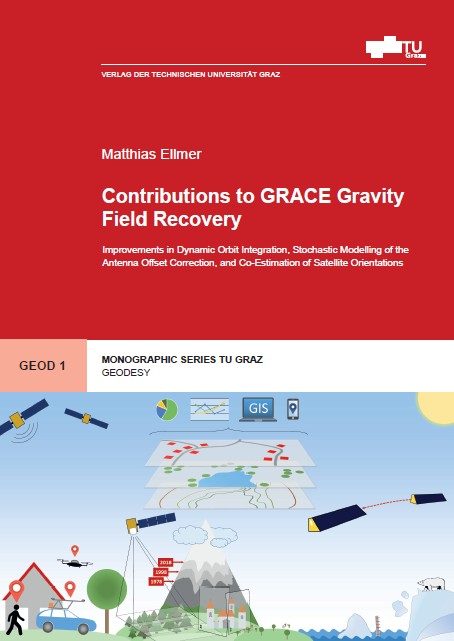
Matthias Ellmer

Contributions to GRACE Gravity Field Recovery

Improvements in Dynamic Orbit Integration Stochastic Modelling of the Antenna Offset Correction, and Co-Estimation of Satellite Orientations

Matthias Ellmer
Contributions to GRACE Gravity Field Recovery

Improvements in Dynamic Orbit Integration Stochastic Modelling of the Antenna Offset Correction, and Co-Estimation of Satellite Orientations

Issue: Open Access E-Book
ISBN: 978-3-85125-646-8
Language: Englisch
Release date: December 2018
Series: Monographic Series TU Graz / Geodesy, Issue 1

Download PDF

Time series of global GRACE-derived surface mass variations have become an invaluable data source in the field of Earth system science. Prominent examples of subject areas that have particularly benefited from GRACE data are the study of the continental hydrological cycle, the cryosphere, and the global ocean mass balance. The work presented within this thesis is part of the community-wide effort to improve the quality of global gravity field solutions based on GRACE satellite-to-satellite tracking observations. Specifically, it is part of and builds on the ITSG-Grace2016 series of gravity field solutions.

The research within this thesis is divided into three main subjects: the study of numerical effects in the dynamic orbit integration necessary in computing GRACE gravity fields; the description and rigorous evaluation of the effect of the spacecraft orientation uncertainty on a correction applied to the GRACE inter-satellite ranging observable; and the co-estimation of improved satellite orientations within the least squares adjustment for the gravity field parameters.

Regarding the topic of dynamic orbits, a modified Encke approach is introduced which allows for the integration of dynamic orbits at a numerical resolution that is shown to be sufficient for GRACE-FO processing. To this end, the classical osculating Encke ellipse is replaced with a rigorously optimized reference ellipse parametrised in equinoctial elements. The dynamic orbit integrated based on this algorithm and parametrisation is shown to exhaust machine precision over a large part of the resulting orbits’ frequency spectrum.

Complete covariance matrices for the satellite orientation are propagated to the GRACE KBR antenna offset correction. The propagated covariance matrices describe the non-stationary contribution of noise in the satellite orientation observations on the correction applied to the inter-satellite ranging observations. This information is incorporated into the estimation of a complete stochastic model for the inter-satellite ranging observations, which is computed anew for each month of data. The improved stochastic model better describes the noise found in real observations, and can thus contribute in the determination of better gravity field solutions.

The covariance information for the satellite orientation is further used in the co-estimation of improved orientation parameters in the least squares adjustment for the gravity field parameters. Departing from the assumption of error-free and fixed satellite orientations leads to a reduction in temporal variability of the recovered gravity fields over the oceans. This methodology further improves estimates of the KBR antenna phase centre coordinates.
  • Description
Creative Commons Licence:

This work is licensed under the Creative Commons Attribution License 4.0 (CC BY 4.0) https://creativecommons.org/licenses/by/4.0/


Sorry, this entry is only available in Deutsch.

Time series of global GRACE-derived surface mass variations have become an invaluable data source in the field of Earth system science. Prominent examples of subject areas that have particularly benefited from GRACE data are the study of the continental hydrological cycle, the cryosphere, and the global ocean mass balance. The work presented within this thesis is part of the community-wide effort to improve the quality of global gravity field solutions based on GRACE satellite-to-satellite tracking observations. Specifically, it is part of and builds on the ITSG-Grace2016 series of gravity field solutions.

The research within this thesis is divided into three main subjects: the study of numerical effects in the dynamic orbit integration necessary in computing GRACE gravity fields; the description and rigorous evaluation of the effect of the spacecraft orientation uncertainty on a correction applied to the GRACE inter-satellite ranging observable; and the co-estimation of improved satellite orientations within the least squares adjustment for the gravity field parameters.

Regarding the topic of dynamic orbits, a modified Encke approach is introduced which allows for the integration of dynamic orbits at a numerical resolution that is shown to be sufficient for GRACE-FO processing. To this end, the classical osculating Encke ellipse is replaced with a rigorously optimized reference ellipse parametrised in equinoctial elements. The dynamic orbit integrated based on this algorithm and parametrisation is shown to exhaust machine precision over a large part of the resulting orbits’ frequency spectrum.

Complete covariance matrices for the satellite orientation are propagated to the GRACE KBR antenna offset correction. The propagated covariance matrices describe the non-stationary contribution of noise in the satellite orientation observations on the correction applied to the inter-satellite ranging observations. This information is incorporated into the estimation of a complete stochastic model for the inter-satellite ranging observations, which is computed anew for each month of data. The improved stochastic model better describes the noise found in real observations, and can thus contribute in the determination of better gravity field solutions.

The covariance information for the satellite orientation is further used in the co-estimation of improved orientation parameters in the least squares adjustment for the gravity field parameters. Departing from the assumption of error-free and fixed satellite orientations leads to a reduction in temporal variability of the recovered gravity fields over the oceans. This methodology further improves estimates of the KBR antenna phase centre coordinates.
Related products

  • Andreas Kvas

    Estimation of High-Frequency Mass Variations from Satellite Data in near Real-Time

    OPEN ACCESS E-BOOK

    Read more
  • Christopher Albert

    Hamiltonian Theory of Resonant Transport Regimes in Tokamaks with Perturbed Axisymmetry

    OPEN ACCESS E-BOOK

    Read more
  • Christopher Albert

    Hamiltonian Theory of Resonant Transport Regimes in Tokamaks with Perturbed Axisymmetry

    € 36.00 Add to cart
  • Marco Zank

    Inf-Sup Stable Space-Time Methods for Time-Dependent Partial Differential Equations

    OPEN ACCESS E-BOOK

    Add to cart
  • Catalog
    • Architecture
    • Civil Engineering Sciences
    • Electrical and Information Engineering
    • Computer Science and Biomedical Engineering
    • Interdisciplinary
    • Mechanical Engineering and Economic Sciences
    • Technical Chemistry, Chemical and Process Engineering, Biotechnology
    • Technical Mathematics, Physics and Geodesy
  • Sale
  • Open Access publications
  • Series
    • Akademische Reden an der Technischen Universität Graz
    • Arbeitshilfen für die Praxis
    • Archiv und Bibliothek
    • Betonkolloquium
    • Buddhist Architecture in the Western Himalayas
    • BWL Schriftenreihe
    • Electrical Power Systems
    • Fachbücher Planung und Bau
    • Facts & Figures
    • Festschriften TU Graz
    • Forschungsreihe IBBW
    • Forum Technik und Gesellschaft
    • Geodesy
    • Immersive Learning Research Network Conference; Workshop, short papers, poster
    • LM.VM.2014
    • Logistik Werkstatt Graz
    • Materialien zu Schwerpunkten am Institut für Gebäudelehre
    • Mathematical Modelling of Weld Phenomena
    • Monographic Series TU Graz
    • Monographic Series TU Graz|Advanced Materials Science
    • Monographic Series TU Graz|Computation in Engineering and Science
    • Monographic Series TU Graz|Production Science and Management
    • Monographic Series TU Graz|Railway Research
    • Monographic Series TU Graz|Reihe Fahrzeugtechnik
    • Monographic Series TU Graz|Schriftenreihe des Instituts Betonbau
    • Monographic Series TU Graz|Structural Analysis
    • Monographic Series TU Graz|Techno- und sozioökonomisch orientierte Betriebswirtschaft
    • Monographic Series TU Graz|Technoökonomie und industrielles Management
    • Monographic Series TU Graz|Timber Engineering & Technology
    • November Talks
    • Proceedings of the International Brain-Computer Interface
    • Projektmanagement in der Bau- und Immobilienwirtschaft|Level D Bauprojekt Management
    • Schriftenreihe des Instituts für Baubetrieb und Bauwirtschaft
    • Schriftenreihe des Instituts für Straßen- und Verkehrswesen
    • Schriftenreihe des Instituts für Wohnbau der TU Graz
    • Schriftenreihe zur Wasserwirtschaft
    • Science, Technology and Society online
    • Seminarreihe Bauunternehmensführung
    • Studien zur Architektur | TU Graz
    • Textbook Series
    • TU Graz Jahresbericht | Annual report
    • TU Graz people
    • TU Graz Research
    • VKM-THD Mitteilungen; IVT-Mitteilungen ab Bd. 100
  • Authors
  • Events
    • Archiv


Contact

Verlag der
Technischen Universität Graz

Technikerstraße 4
8010 Graz, Österreich
UID(VAT) ATU 57477929

contact person

Gabriele Groß
Tel.: +43(0)316 873 6157
E-Mail: verlag [ at ] tugraz.at


back to TU© 2026 TUGraz | powered by